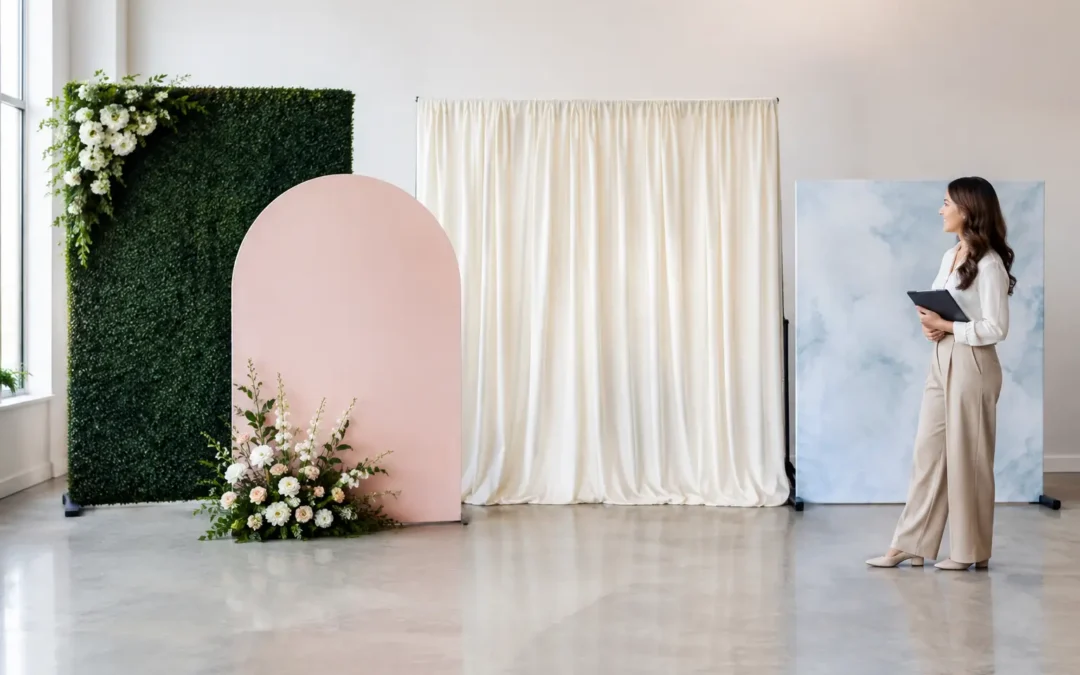
A beautiful backdrop can make a modest corner of a venue feel like the centrepiece of the celebration. But even the most exquisite florals, shimmer walls or custom signage can lose their impact if the proportions are wrong. This backdrop hire size guide will help you choose a backdrop that frames your guests beautifully, suits your venue and gives every photo a polished, elevated finish.
The right size is not simply about fitting the available wall. It is about creating enough visual presence for the moment you want to capture – whether that is a newlywed portrait, a queue of guests at a photo booth, a product launch reveal or a large family photo at a milestone birthday.
Start with the photo moment
Before choosing dimensions, decide what the backdrop needs to do. A backdrop placed behind a cake table has a different job from one designed as an all-night photo moment. Likewise, a corporate media wall needs to accommodate groups, branding and photographers moving quickly, while a wedding ceremony backdrop needs to look breathtaking from every seat in the room.
Think about who will stand in front of it and how they will use it. A couple, a cake display or a pair of light-up numbers can work beautifully against a narrower backdrop. If you expect groups of four, six or more guests to pose together, extra width matters. No one wants the guests at either end cropped against the edge of the styling.
Height deserves equal consideration. Taller backdrops create a more luxurious sense of scale, particularly in ballrooms, marquees and venues with high ceilings. In an intimate restaurant function room or private home, however, a very tall structure can feel overpowering. The goal is considered proportion, not simply choosing the largest option available.
Backdrop hire size guide: common dimensions
While every installation should be considered against the venue and event design, these common sizes provide a practical starting point.
| Backdrop size | Best suited to | What it creates | | — | — | — | | 1.5m to 2m wide | Cake tables, welcome signs, baby showers and intimate portraits | A refined focal point without taking over the room | | 2.4m to 3m wide | Couples, small families, engagement parties and compact photo areas | A generous, photo-ready statement for small groups | | 3.6m to 4m wide | Weddings, birthdays, school formals and photo booths | Comfortable space for groups and a stronger visual impact | | 5m or wider | Corporate activations, media moments and large guest areas | A high-impact feature that can handle crowds and brand presence |
For height, 2.1m to 2.4m is a popular choice for many indoor celebrations. It photographs well, fits comfortably in most venues and gives floral or balloon styling enough room to feel abundant. A 2.4m to 3m height is particularly effective when you want a dramatic flower wall, layered draping or a large-scale branded installation.
These measurements are a guide, not a rule. A 3m-wide backdrop may be ideal for a wedding reception with seated dinner service, but a 4m option can be the smarter choice if it will sit beside a photo booth where guests are likely to pose in larger groups throughout the evening.
Match the backdrop to the number of guests in each photo
Guest count alone does not determine backdrop size. What matters is the number of people likely to be in a single photograph. At a 150-person wedding, most photos might feature two to five guests at a time. At a school formal or corporate Christmas party, guests often gather in larger friendship groups, so a wider setting is usually worthwhile.
For one or two people, allow enough width for relaxed posing rather than placing them directly against the edges. For three to five people, a 2.4m to 3m backdrop generally gives a balanced composition. For six to eight people, 3.6m or more allows everyone to stand naturally without turning the shot into a tight squeeze.
Also consider movement. A photo booth experience is more playful than a formal portrait. Guests will use props, lift champagne glasses, dance, lean in and bring friends into the frame. A little extra space protects the look of the backdrop and makes the experience feel effortless.
Consider the venue, not just the floor plan
A venue may technically have space for a large backdrop, yet still not be the right setting for one. Check the ceiling height, nearby doors, air-conditioning vents, wall finishes, access points and furniture placement. A backdrop should have breathing room around it, rather than appearing wedged between a bar and a fire exit.
As a helpful visual rule, leave approximately 30cm to 50cm of clear space at either side where possible. This helps the feature read as intentional and gives suppliers room to install it safely. If the backdrop is paired with plinths, florals, light-up letters or a cake table, account for the full styling footprint rather than the backdrop frame alone.
Ceiling height can change the decision quickly. In a room with a 2.7m ceiling, a 2.4m backdrop may be the maximum that feels comfortable, especially once installation hardware is considered. In a grand reception space with tall ceilings, a low backdrop can look visually lost. Larger floral styling, layered panels or taller draping can restore the sense of occasion.
Outdoor events bring another consideration: wind. A substantial backdrop requires appropriate stabilisation, suitable ground conditions and a location that protects both guests and the installation. It may be safer and more effective to select a smaller, carefully styled feature in an exposed setting.
Choose width based on the feature around it
Your backdrop rarely stands alone. The width should complement what sits in front of it. A cake table usually looks most balanced when the backdrop extends beyond the table on both sides, creating a deliberate frame for the cutting photos. For a bridal table, consider the full length of the table and where the couple will be seated, rather than selecting a backdrop based only on the couple’s chairs.
With light-up letters, choose a backdrop wide enough to avoid a crowded, layered look. The letters should sit in front with clear separation, allowing both features to photograph beautifully. For a flower wall or shimmer wall used as a photo moment, wider is often better because the backdrop itself is the attraction.
Corporate events need a similarly thoughtful approach. A branded backdrop that is too narrow can make group photos feel awkward and leave logos partly obscured. If the backdrop includes repeated branding, the design should still look intentional when guests stand in front of it. Allow space for key marks to remain visible at the sides and above the group.
Do not forget the camera angle
A backdrop can look ideal in person but photograph differently depending on the camera position. Phone cameras, professional photographers and photo booth cameras each have their own framing. A photo booth placed close to the backdrop may capture less width than expected, while a photographer with room to step back can work with a larger installation.
Ask where the camera or booth will sit, and whether guests will be photographed vertically, horizontally or both. Vertical content is particularly relevant for social sharing, reels and stories, where height and a strong central focal point can be more valuable than extreme width. Horizontal group photos generally benefit from a broader backdrop.
Lighting also changes the result. Glossy shimmer backdrops, mirror details and metallic finishes create spectacular movement under event lighting, but they need considered placement to avoid harsh reflections. Soft floral walls and draping are more forgiving in varied light, while custom signage needs enough contrast to remain readable in photographs.
When a larger backdrop is worth it
There are occasions where choosing the larger option delivers noticeably better value. A wide backdrop is worthwhile when it will be used from guest arrival through to late-night photos, when the room is large, or when it forms the visual anchor for multiple services such as a photo booth, florals, light-up letters and dry ice moments.
It is also a smart investment when the backdrop appears in professional photography or brand content. The difference between a backdrop that merely fills a gap and one that establishes an unforgettable visual moment is often found in scale, finish and placement.
At R&L Magical Moments, the best installations begin with a clear picture of the event flow: where guests arrive, where they gather, what they will photograph and which moments deserve the biggest sense of spectacle. Share your venue dimensions, a few room images and the purpose of the backdrop early. From there, the right size becomes less of a guess and more of a beautiful decision that lets every guest step into the frame with confidence.